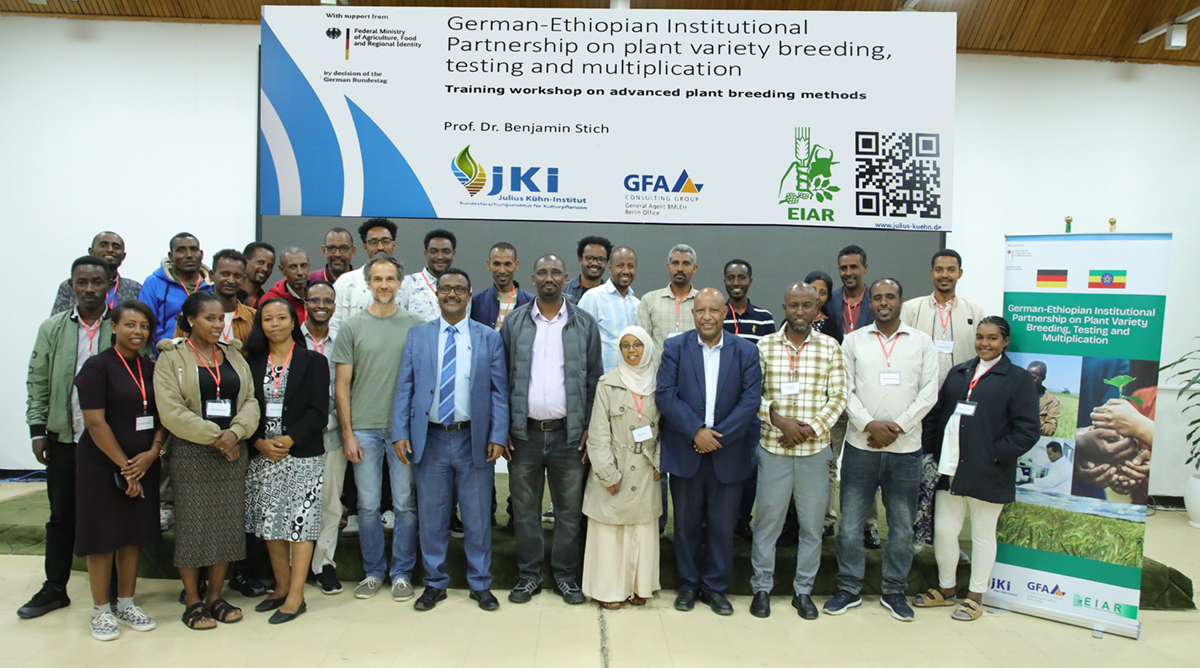
The Julius Kühn Institute (JKI) recently organized a four-day training workshop on the fundamentals of modern plant breeding methods at the Ethiopian Institute of Agricultural Research (EIAR) in Addis Abeba from 13 to 16 July 2026.
The workshop was led by JKIs breeding expert, Professor Benjamin Stich, who leads the JKI-Institute for Breeding Research on Agricultural Crops. 25 plant breeders and scientists from research centres from all across Ethiopia participated. The training strengthened the participants' understanding of modern plant breeding approaches and their practical application according to international standards.
The program combined lectures with practical exercises, enabling participants to apply newly acquired knowledge directly. A key component of the workshop was hands-on training using the open-source statistical software R, which is widely used for analysing breeding data and designing modern plant breeding programs.
Information on the German-Ethiopian institutional partnership:
The workshop-format is part of the bilateral project "German-Ethiopian Institutional Partnership on Plant Variety Breeding, Testing and Seed Multiplication", which was launched in April 2026 in the framework of the Bilateral Cooperation Program (BKP) of the German Federal Ministry of Agriculture, Food and Regional Identity (BMLEH). The partnership aims to strengthen technical expertise in plant breeding, variety testing and seed multiplication while fostering long-term scientific cooperation and institutional exchange between Germany and Ethiopia.
The institutional partnership between JKI and EIAR includes training activities, research exchanges and technical study visits. By promoting knowledge transfer and capacity building, it contributes to strengthening modern plant breeding in Ethiopia and supports the development of productive, climate-resilient and sustainable agricultural systems.