
Dr Izhar Ullah of Ondokuz Mayis University in Samsun, Turkey is currently conducting his research at JKIs’ Institute for breeding research on fruit crops. After obtaining an Alexander von Humboldt Research Fellowship for postdocs Ullah chose to work at Dresden. We wanted to know, what brought the Humboldt-fellow to Germany and what drives him.
Humboldt Fellow Izhar Ullah is at JKI Dresden in “cherry good” company
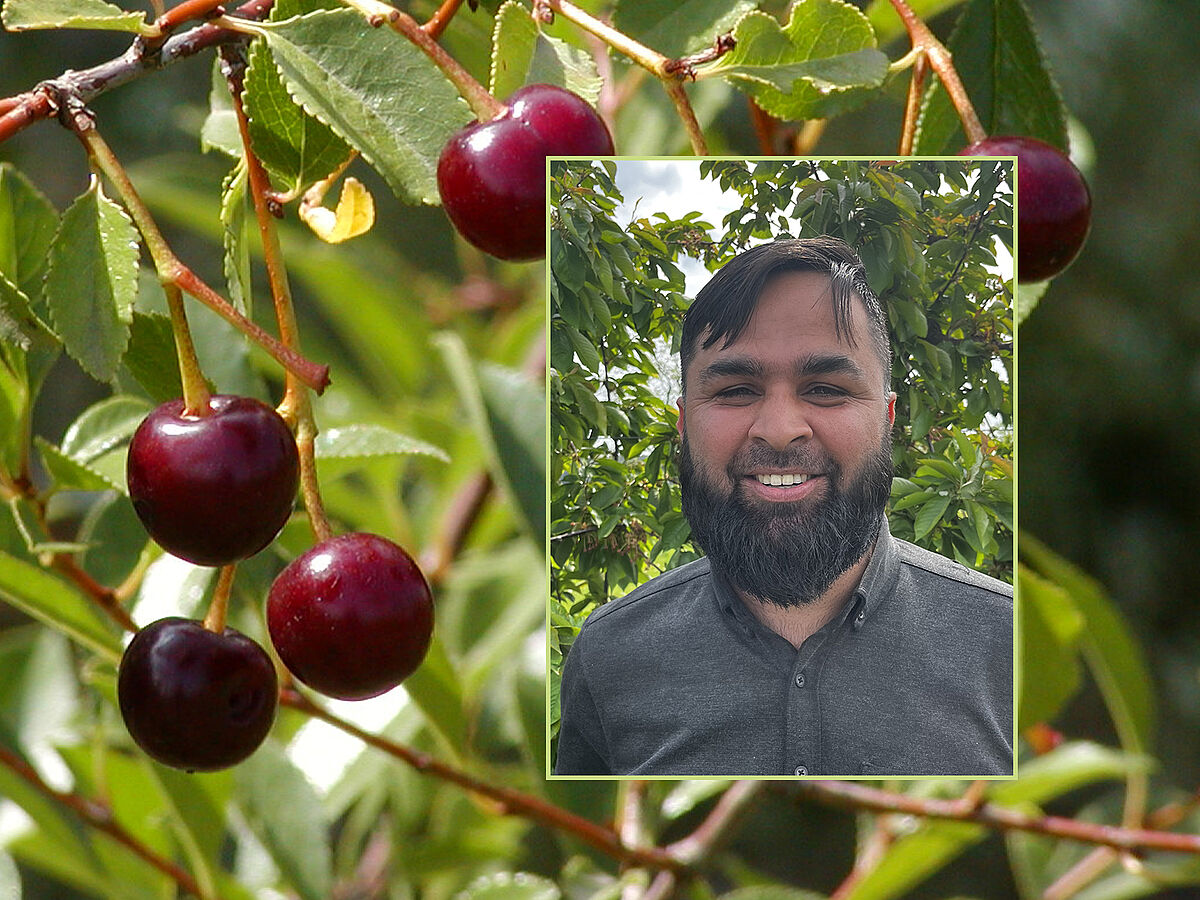
Dear Dr Ullah, why are you so interested in plant genetics and genomics?
In my school days, I was amazed by how plants react to their surroundings and how naturally they evolve to defend themselves against diseases and stress. This initial interest grew into a research interest how plants could adapt and resist disease on a molecular level. Plant genetics and genomics have an enormous potential for revealing the genes and molecular pathways behind these important traits. My specific focus is on the genetics of resistance in cherry species, genetic mapping and transcriptomics, and using this information to facilitate sustainable breeding strategies.
Your research focuses on the cherry leaf spot disease and resistance in Prunus. Why is this topic important for modern fruit breeding?
Cherry Leaf Spot (CLS) is caused by the fungus Blumeriella jaapii and is one of the most damaging diseases affecting cherry production worldwide. It has the potential to decrease tree vigour, fruit value and production, which will result in greater reliance on fungicide use and increased production expenses. Prunus fruticosa is a progenitor of sour cherry and represents a valuable genetic resource for breeding programmes. A previous study identified regions in sour cherry specific to the subgenome P. fruticosa, which are associated with CLS resistance. Investigating the genetic and molecular base of CLS resistance in this species could lead to the identification of CLS resistance genes/genetic markers that can be incorporated into breeding programs. This information will hopefully help develop disease-resistant cherry cultivars, lessen the need for chemical control, and contribute to sustainable fruit production.
When did you first hear about the JKI, and what made you decide to work with us during your Humboldt funding period?
I first heard about the JKI in 2024 through a colleague in my laboratory at Ondokuz Mayıs University, who was selected for an Erasmus-internship at JKI but, unfortunately, could not come to JKI. But I took a closer look on JKI’s research, especially on their breeding research on fruit crops in Dresden, which sparked my interest. Their research excellence and strong focus on translating genomics into practical breeding applications motivated me to pursue the opportunity to work there. The Humboldt Research Fellowship provides me with a great opportunity to work with experienced researchers, gain knowledge of genetic resources and breeding populations, and at the same time contribute to current genomics and breeding initiatives at JKI, a win-win-situation.
How has the Humboldt Research Fellowship supported your scientific work and international collaboration so far?
The Humboldt Research Fellowship has enabled me to work in a highly advanced research environment and interact with experts in plant genetics and fruits on an international level. Through the fellowship, I have succeeded not only in expanding my circle of connections within the international scientific community but also established an effective cooperation with specialists at the Institute and other organizations. This exchange of knowledge and expertise is helping me to improve the quality of my research and gain international exposure.
What are the most exciting developments currently happening in plant genomics and plant breeding research?
A recent and fascinating development in plant genomics and breeding is the substantial progress in high-throughput sequencing technologies, which can enable us to build high-quality genomes and explore genetic diversity in a fundamentally new way. Methods such as "pangenomics" are uncovering the extend of structural and functional variation within species, which is extremely informative for the identification of different plant characteristics, such as disease resistance.
In parallel, the application of multi-omic approaches, including the integration of transcriptomics, genome-wide association studies, and genetic mapping, contributes to better detection of genotype-phenotype associations. Furthermore, innovations in gene editing and advanced bioinformatics pipelines assist researchers in the discovery and validation of candidate genes in crops. Specifically in Europe, the current decision of the European Parliament on gene-edited crops will facilitate and drive new breeding techniques to the next level. Overall, the combination of multi-omics approaches and modern breeding technologies is transforming plant breeding into a more precise, data-driven, and efficient discipline, with great potential to develop resilient and high-yielding crop varieties for future agricultural challenges.
How do you like Dresden and the surrounding area so far?
It have had a great time enjoying the beautiful landscape and cultural heritage of Dresden along the Elbe River, especially the nearby Pillnitz Castle. Being located in one of Germany’s important fruit-growing regions is particularly inspiring for my research, as it provides a direct connection between scientific work and practical fruit production systems.
Dresden also has a lively “science scene” of international standing, as well as excellent research infrastructure and collaboration opportunities. The plentiful availability of a desirable fruit-growing area, coupled with a well-networked research community, makes it the perfect location to continue my research into disease resistance in Prunus species and sustainable fruit breeding.
What advice would you give to young researchers who would like to work in plant genetics and genomics in the future?
As for young scientists interested in plant genetics and genomics, I would recommend that they develop solid knowledge in genetics, molecular biology, and data analysis, as this area is increasingly dominated by large-scale genomic data. It is important to have practical experience with real datasets and a commitment to interdisciplinary approaches, particularly the integration of biology and bioinformatics. Determination and curiosity come in handy, when exploring complex traits such as disease resistance, the research will be time consuming and requires teamwork.
Backround information:
The aim of the research project of Dr Izhar Ullah is to explore the molecular mechanisms behind the resistance to Cherry Leaf Spot (CLS) in Prunus species. The study combines genetic mapping and transcriptomic methods to find resistance genes and pathways associated with resistance to CLS. His research will help identify resistant cultivars for sustainable fruit production, as well as provide genomic resources for breeding. The Humboldt fellow postdoc works at the JKI in Dresden since May 2026 for a total of 24 months. As head of the institute Prof Dr Henryk Flachowsky is his host and Dr Ofere Francis Emeriewen serves as his direct supervisor.
Veröffentlicht am