

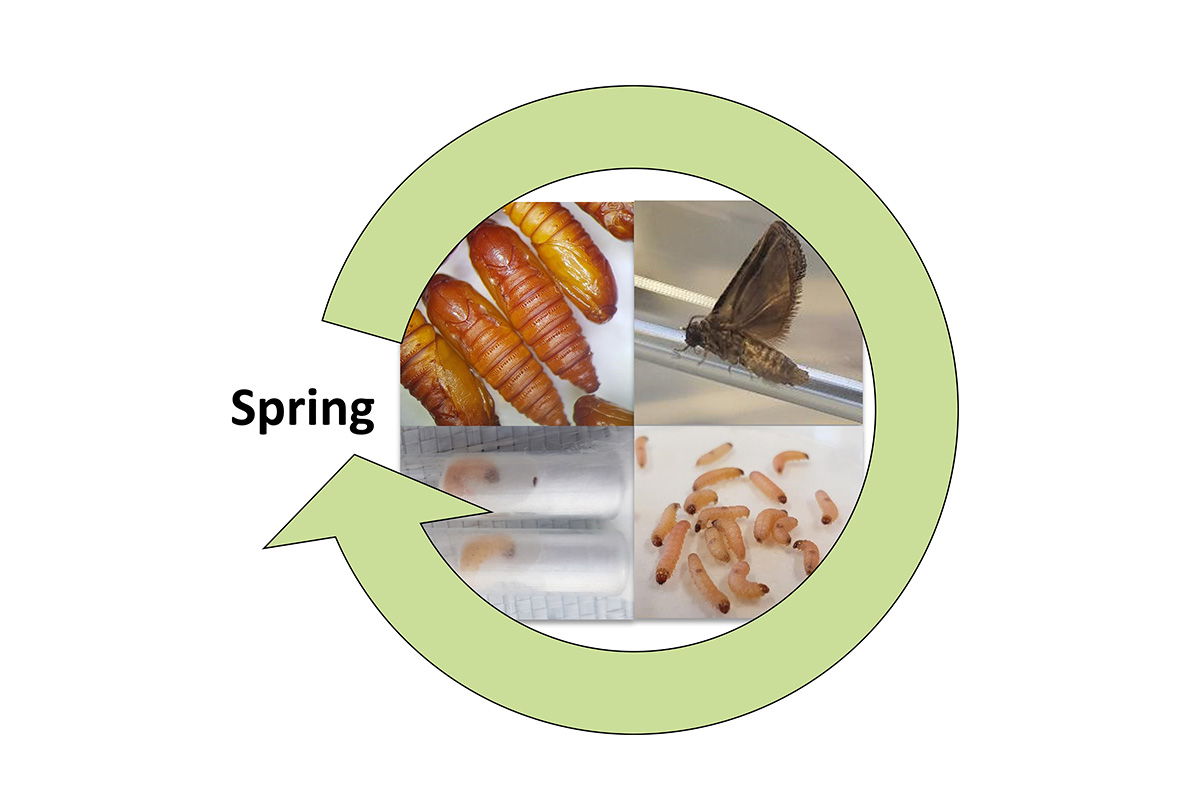
To survive cold temperatures and food scarcity, insects hibernate in a state of dormancy known as diapause. In autumn, the larvae of codling moth (Cydia pomonella) spin itself into a cocoon before pupating in spring. Depending on the time of pupation, one or several generations of pests can develop during the summer months. A research team from our institute, the Laimburg Research Centre and the MPI for Chemical Ecology has now succeeded in shedding light on the hidden life of the codling moth diapause. Unlike other insects, the codling moth extends the end of its diapause over several weeks or months. In a selection experiment at Laimburg - lasting more than 15 years - two codling moth strains were selected and genetically fixed, differing in their pupation time-point by more than 2 months. With the help of extensive crossing experiments between the two strains, it has now been demonstrated that the genetic factors responsible for this developmental control are located on several chromosomes of the codling moth genome and thus contribute to a highly complex diapause control. The investigations also provided evidence that global warming has an impact on the timing of pupation. Between 2007 and 2022, pupation has shifted earlier by 0.6 days each year and now begins about two weeks earlier than it did 25 years ago.
Based on these results, the genetic factors on the chromosomes of the codling moth are currently being identified. From these research it is expected to better predict the occurrence of the codling moth in different climates and regions. .
See new publication: Oehlmann et al. (2025). Journal of Insect Physiology 167 (2025) 104904