

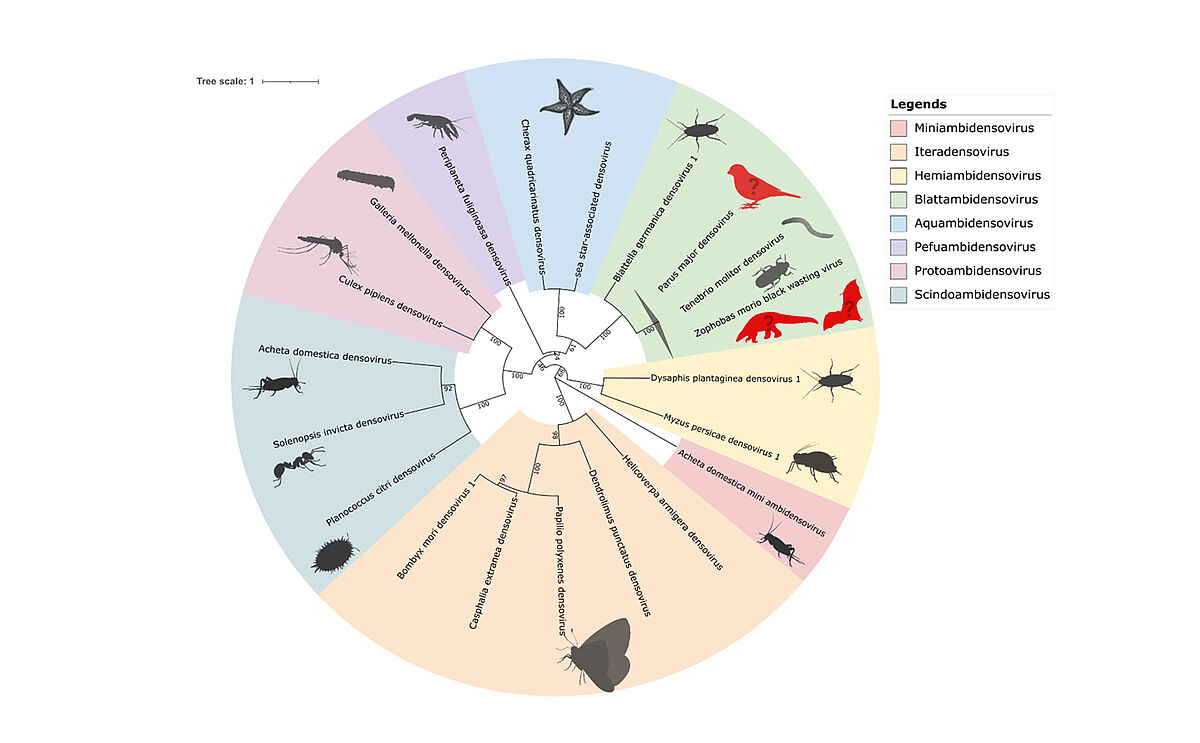
Tenebrio molitor is one of the most important insects reared on the industrial scale for food and feed. However, mass-rearings carry the risk of rapid spread of insect pathogens. In T. molitor, the Tenebrio molitor densovirus (TmDV) is particularly relevant and pose a threat to a healthy insect population. In the present study, samples of the TmDV, which were collected from a commercial mealworm facility, were investigated metagenomically using Nanopore sequencing. TmDV was detected in larvae, pupae, and adults – both in symptomatic and apparently healthy individuals. Various genotypes of TmDV were reconstructed, which occurred simultaneously in the population. In addition, reinfection experiments confirmed that T. molitor can be successfully re-infected by TmDV, confirming that the mealworm is susceptible hosts for TmDV. Interestingly, infection with TmDV tended to be asymptomatic. Mortality was only observed at very high virus doses. Comparative phylogenetic analyses showed that previously published virus sequences detected in bird, bat, and pangolin metagenomes belong to the same virus species (Blattambidensovirus incertum1). However, these are not due to actual infections, but represent purely metagenomic evidence. The vertebrates probably ingested the TmDV by feeding on TmDV infected mealworms. The results underscore the risk of metagenomic studies, in which the detection of a virus does not necessarily imply an actual relationship between host and pathogen.
Lim, F. S., González-Cabrera, J., Jehle, J. A., Lefebvre, T., & Wennmann, J. T. (2026). No longer uncertain: the validation of tenebrionid insects as hosts of Blattambidensovirus incertum1 isolates by phylogeny and infection studies. Journal of General Virology, 107(2), 002211. https://doi.org/10.1099/jgv.0.002211